
From a vantage point 1336 kilometers (830 miles) above the Earth, the US/European ocean altimeter satellites measure the height of the ocean surface directly underneath the satellite with an accuracy of 4-5 centimeters (better than 2 inches). Traveling in excess of 7 kilometers (4 miles) every second as they trace out an orbit, the spacecraft cover the global oceans every 10 days (the "repeat period" of the satellite orbit).
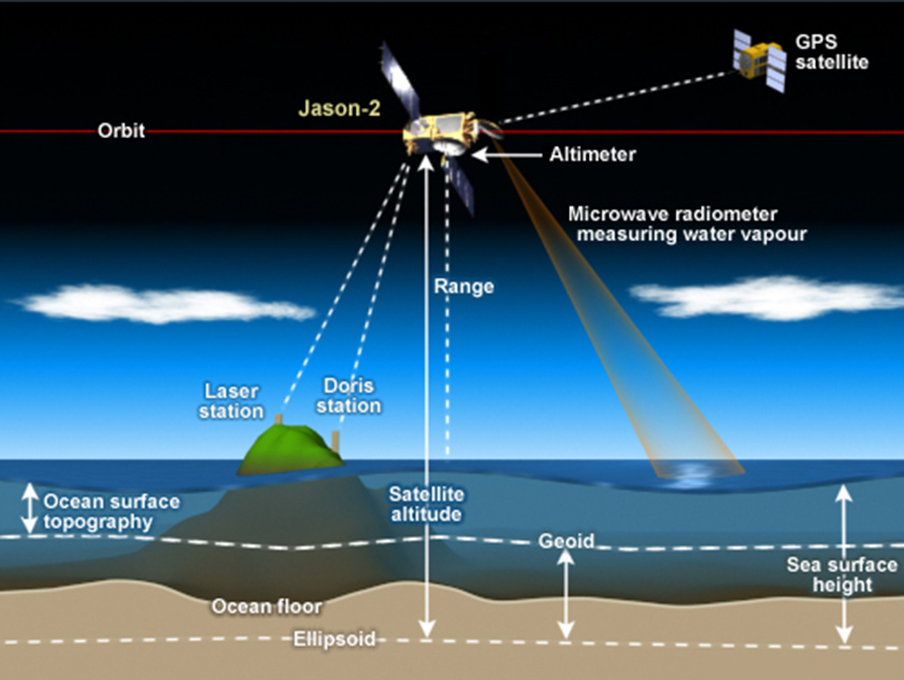
The accurate determination of the ocean height is made by first characterizing the precise height of the spacecraft above the center of the earth. This is achieved through a technique called "precise orbit determination" (POD), of which satellite-tracking information is the most important ingredient.
The baseline tracking system for these satellites is the onboard NASA retroreflector array, which serves as a target for 10 to 20 satellite laser ranging (SLR) stations that dot Earth's surface. The CNES DORIS (Doppler Orbitography and Radiopositioning Integrated by Satellite) system provides an important additional set of tracking data. Anchored by about 60 ground stations, the DORIS receiver measures the Doppler shift of microwave signals to support POD. NASA's GPS receiver systems onboard the spacecraft provide precise, continuous tracking of the position by monitoring range and timing signals from up to 12 GPS satellites at the same time.
In order to produce accurate estimates of the satellite orbital height, POD combines the satellite tracking information with accurate models of the forces (e.g., gravity, aerodynamic drag) that govern the satellite motion. For these missions, this process supports the determination of the satellite orbital height with an accuracy of about 1 centimeter (0.5 inches).
The second component of the ocean height measurement is the range from the satellite to the ocean surface. Each spacecraft carries a radar altimeter that provides this information: the CNES Poseidon-3 instrument, the latest model on Jason-3, emits microwave pulses at frequencies of 13.6 and 5.3 GHz. To take a measurement, the onboard altimeter bounces these pulses off the ocean surface and measures the time it takes the pulses to return to the spacecraft. This measurement, multiplied by the speed of light, gives the range from the satellite to the ocean surface. After correction for atmospheric and instrumental effects, the range measurements are accurate to less than 3 centimeters. The range measurements are subtracted from POD-derived estimates of the satellite orbital height, resulting in ocean height measurements that are good to 3 centimeters (just over 1 inch) relative to the center of the earth.
This accuracy figure pertains to a few-kilometer spot on the ocean surface directly beneath the satellite. By averaging the few-hundred thousand measurements collected by the satellite in the time it takes to cover the global ocean (10 days), global mean sea level can be determined with a precision of several millimeters.
To verify the accuracy of measurements independently, CNES and NASA each established a verification site along the ground track of the satellite. The CNES verification site is on the French island of Corsica in the Mediterranean Sea; the NASA site is on the Harvest, an offshore oil rig at the eastern entrance to the Santa Barbara Channel, off the coast of central California. Each site is equipped with tracking systems (e.g., GPS, SLR) that enable accurate surveying of the stations into the reference frame that underlies the satellite orbit computations (POD). This survey information is combined with local measurements of the water level (from tide gauges) to derive an independent estimate of the ocean height relative to the center of the earth. Every 10 days the Jason-3 satellite flies directly overhead, and the two independently derived measurements of the instantaneous sea level (satellite vs. "ground truth") are compared in an analysis called "closure." With sufficiently redundant instrumentation at the experiment site, along with careful monitoring of potential systematic errors, any unexpected mismatch between the satellite and "ground truth" measurements can be attributed to an error in the satellite measurements. The "closure" data from Corsica and Harvest, along with similar information from other verification sites and observing programs, are used to continuously monitor the performance of these ocean altimeter satellite measurement systems.
-
Configuration in Corsica Image Credit: OCA-CERGA/CNES
-
Harvest Platform Image Credit: Daniel G. Kubitschek (JPL)