
El Niño/La Niña Watch & PDO
The data from the TOPEX/Poseidon and Jason missions help us study and understand the complex interactions between the ocean and the atmosphere that affect global weather and climate events. El Niño is one well-known example of this interaction.
Learn more about this and other important climate phenomena in the links below.
-
El Niño 2023
Learn about the 2023 El Niño.Historical El Niño/La Niña Watch
Here you will find images and news releases.Learn More About it
Read about this phenomenon that affects us all.PDO - Pacific Decadal Oscillation
Find out more about this long-term ocean fluctuation.El Niño/La Niña Movies
Watch Sea Surface Height (SSH) animations of TOPEX/Poseidon and Jason data.Educational and other links
Want to learn more? Follow these links for more details.
Learn More About El Niño/La Niña & PDO
El Niño
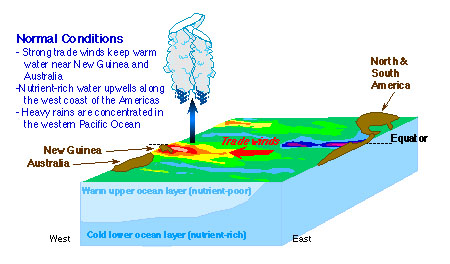
El Niño was named by people who fish off the western coast of central America to refer to the warm current that invades their coastal waters around Christmastime. El Niño events disrupt fisheries and bring severe weather events worldwide.
In a normal year, the trade winds blow westward and push warm surface water near Australia and New Guinea. When warm water builds up in the western Pacific Ocean, nutrient-rich cold water comes up off the west coast of South America and fosters the growth of the fish population.
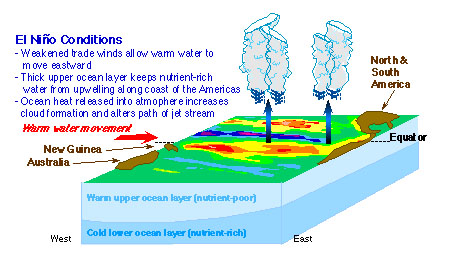
During an El Niño event, the trade winds weaken and warm, nutrient-poor water occupies the entire tropical Pacific Ocean. Heavy rains that are tied to the warm water move into the central Pacific Ocean and cause drought in Indonesia and Australia. This also alters the path of the atmospheric jet stream over North and South America.
The effects of El Niño disrupt normal winter conditions throughout the Pacific Ocean, and can persist into May or June. Reliable predictions of an El Niño occurrence will lead to better preparation for its widespread impact.
La Niña
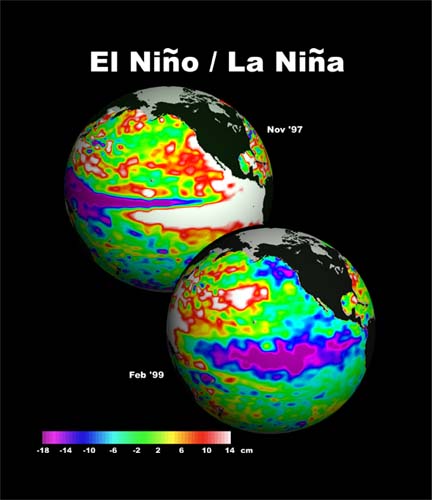
Warm El Niños and cold La Niñas follow each other against the backdrop of the ocean seasons. During a La Niña, the trade winds are stronger, and cold, nutrient-rich water occupies much of the tropical Pacific Ocean. Most of the precipitation occurs in the western tropical Pacific Ocean, so rain is abundant over Indonesia.
Pacific Decadal Oscillation (PDO)
The Pacific Decadal Oscillation (PDO) is a long-term ocean fluctuation of the Pacific Ocean. The PDO waxes and wanes approximately every 20 to 30 years.
Additional Information on El Niño/La Niña and PDO
Image series
El Niño/La Niña explained (basics and links)
Links to El Niño/La Niña Information
NOAA's Climate & Regional Weather Forecasts
El Niño/La Niña Education
On-line El Niño and altimetry slides - a undergraduate and educator primer
El Niño/La Niña & PDO Links
El Niño/La Niña Information on the Web
There are many excellent sites containing basic information on these phenomena, the effects of El Niño and La Niña on weather and climate, and forecasts.
Major sites containing background information
- An El Niño and La Niña Theme Page - a comprehensive primer with access to relevant data, information on effects, and predictions. If you are just going to visit one site, this is probably the one!
- The ENSO cycle - processes and displays of relevant data
Climate and regional weather forecasts
- NOAA Climate Prediction Center/El Niño and La Niña - provides a continuous watch on short-term climate fluctuations and works to diagnose and predict them
- Regional Forecasts for El Niño - El Niño and current situation as it relates to the ENSO cycle
Spaceborne monitoring tools
- El Niño Watch from Space - an overview of spaceborne sensors critical to monitoring the ENSO cycle
- Understanding our Oceans & Climate from Space - the role of space-borne altimeters in detecting El Niño/La Niña